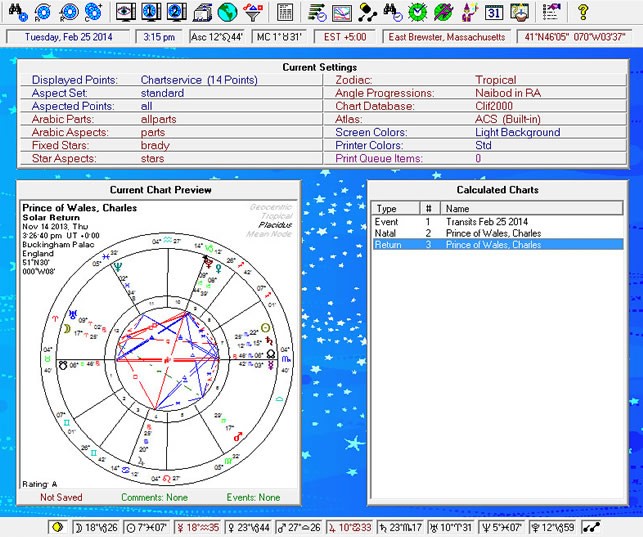
In Mundane Astrology, finance, stock markets, and economic cycles are analyzed through planetary positions, aspects, and house activations.
- 2nd House: national wealth, financial resources, commodity markets
- 8th House: banking, credit, debt, taxation, economic redistribution
- 10th House: government economic policies, financial regulations, market oversight
- Jupiter, Saturn, Mercury, Venus, and Mars: key planets influencing financial trends
By tracking transits, progressions, and eclipses, astrologers can forecast market booms, recessions, currency shifts, and national economic stability.
🔹 Key Planetary Influences
♃ Jupiter – Economic Growth, Market Expansion, and Wealth Distribution
- Jupiter governs financial prosperity, stock market growth, and national economic expansion.
- Positive aspects → bull markets, economic growth, wealth generation.
- Challenging aspects → overextension, inflation, speculative risks.
Example:
- Post-WWII economic boom (1945–1960): Jupiter aspects reflected mass economic growth and stock market expansion.
♄ Saturn – Economic Discipline, Regulation, and Recession Trends
- Saturn governs banking regulations, fiscal discipline, and economic constraints.
- Positive aspects → stable financial systems, disciplined economic policies.
- Challenging aspects → recessions, austerity measures, financial crises.
Example:
- Great Depression (1929–1933): Saturn aspects reflected financial contraction, market collapse, and economic hardship.
☿ Mercury – Trade, Banking, and Financial Communication
- Mercury governs banking operations, financial transactions, trade, and market communication.
- Positive aspects → efficient trade, smooth banking operations, accurate financial information.
- Challenging aspects → market misinformation, transaction errors, credit problems.
Example:
- Expansion of modern banking systems (19th century): Mercury aspects reflected improved financial communication and transactions.
♀ Venus – Investments, Market Value, and Economic Appeal
- Venus governs stock market trends, investment attractiveness, and economic sentiment.
- Positive aspects → profitable investments, rising market confidence.
- Challenging aspects → market corrections, speculative risks, financial instability.
Example:
- 1920s US stock market boom: Venus aspects reflected investment optimism and rapid market growth.
♂ Mars – Market Volatility, Speculation, and Economic Action
- Mars governs market activity, speculative trading, and financial risk-taking.
- Positive aspects → energetic market growth, calculated risk-taking.
- Challenging aspects → volatility, crashes, financial conflicts.
Example:
- Stock market crash of 1987 (“Black Monday”): Mars aspects reflected sudden market turbulence and economic shock.
🔹 Houses in Finance, Stock Markets, and Economic Cycles
House | Focus |
|---|---|
| 2nd | National wealth, financial resources, commodity markets |
| 8th | Banking, credit, taxation, debt, financial redistribution |
| 10th | Government economic policies, market oversight, financial regulations |
| 6th | Workforce and productivity influencing economic trends |
🔹 Eclipses and Economic Events
- Eclipses activating 2nd, 8th, or 10th houses → stock market crashes, financial reforms, economic booms or recessions.
- Repeated eclipse cycles → historical patterns in market cycles and national wealth fluctuations.
Example:
- Solar Eclipse 1929 activating 8th house points: coincided with the Wall Street Crash, reflecting a severe financial downturn.
🔹 Practical Mundane Interpretation
- Track Jupiter, Saturn, Mercury, Venus, and Mars for financial and economic influence.
- Observe 2nd, 8th, and 10th house activations in national charts.
- Combine eclipses and outer planet transits to forecast market trends, economic cycles, or financial crises.
- Analyze historical cycles → anticipate recessions, booms, and investment opportunities.
Insight: Mundane astrologers can anticipate market movements, financial stability, and economic cycles using planetary cycles, house activations, and eclipse timing.